An Open Letter to Nancy-Ann DeParle

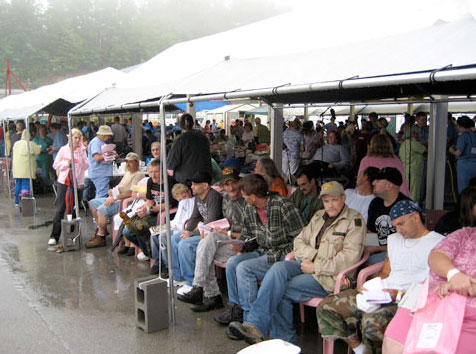
I became convinced of the need for health care reform when I visited the Remote Area Medical's health care fair in Virginia in 2007 and saw people standing or sitting in long lines, waiting to get care. People had driven there from South Carolina, Georgia, Kentucky and Tennessee, desperate for medical care that they were unable to get from insurance companies. I was stunned to see this level of neglect in the United States.
ATTN: Nancy-Ann DeParle, Director of the White House Office of Reform
Dear Nancy-Ann,
First, forgive me for being familiar, but we were introduced by our mutual friend, Scott Lucas, at a University of Tennessee Torchbearers' reunion in Knoxville about 25 years ago. I'm confident that neither of us could have imagined that we would be advocates for health care reform two and a half decades later.
I am writing to invite you and, if their schedules permit, President Obama and Secretary Sebelius, to join me next week at a remarkable event in Los Angeles that I am confident you will never forget. I'm also confident it will inspire you to redouble your efforts, if that is possible, to make certain the President has the privilege of signing a meaningful and comprehensive health care reform bill later this year.
As you may know, I was an executive at two of the country's largest health insurance companies, Humana and CIGNA. As you may also know, I recently testified before the Senate Commerce Committee about how insurance companies confuse their customers and dump the sick -- all so they can satisfy their Wall Street investors.
I left my job a few months after seeing firsthand the consequences of the actions insurance companies take every day to meet those investors' relentless profit expectations. I saw it in the faces of the thousands of people who had been waiting for hours in the rain to get care many of them so desperately needed but couldn't afford because they were either uninsured or underinsured. They had been waiting in long lines since long before daybreak to get care from doctors who were volunteering their time to treat them in animal stalls at a county fairground in Wise County, Virginia, not far from where you and I grew up. Other volunteers had worked for days beforehand to scrub and disinfect those animal stalls and to set up tents that would be used as additional treatment sites. Many of the people who came for care slept in their cars in the fairgrounds parking lot for two days or more to be assured of getting inside the gates.
The organization that made it possible for those folks to get the care they needed was Knoxville-based Remote Area Medical (RAM). RAM's original mission was to provide free care to people who lived in remote villages in third world countries. Soon after it was founded, about the time you and I first met, RAM's founder, a British citizen and former actor named Stan Brock, realized that there was a great and growing need for his organization's services all across America.
RAM has been providing free care in Wise County once a year for 10 years. When I went to the eighth annual "expedition," as RAM calls these events, in July 2007, I was a curious insurance company executive. When I went back last month I was an advocate for comprehensive health care reform and a critic of the many health insurance practices that make it necessary for people to stand in line, in the dark and in the rain, to get care in animal stalls.
The expedition in Los Angeles, to be held at the Forum where the Lakers used to play, will be the biggest one RAM has ever held in the United States and the first one in a major city. It will start at 6 a.m. on Tuesday, August 11 and extend over eight days, far longer than the three days of the Wise County expedition.
I apologize if this seems like short notice. If you and President Obama and Secretary Sebelius cannot attend, please send someone else from the administration, if for no other reason than to meet Stan Brock, one of the most remarkable people you will ever meet, the volunteer doctors and other health care professionals, and, most importantly, a few of the people who will be standing in line to get care.
A final note: I have been called a whistleblower for speaking out against the health insurance industry. I see myself as someone who is simply trying to shine a light on industry practices the industry would rather not be made public. I feel that I am at long last living up the Tennessee Volunteer credo that is inscribed on our Torchbearer plaques: "He that beareth a torch shadoweth himself to give light to others."
Please join me in Los Angeles next week to shed light on the plight that an ever growing number of Americans are finding themselves in as a result of insurance industry practices that should be illegal.


Comments
Invitation to L.A. R.A.M.
What a wonderful idea. I hope Ms. DeParle, Secretary Sebelius and even Pres. Obama take you up on this invitation. And then publicize the heck out of it. How could it not be an eye-opening thing for Americans to see what's going on in their own country?
Eliminating the Managed Care Middleman
Mr. Potter, I applaud your efforts on behalf of the CMD and would like your thoughts on one solution that's been entirely overlooked amidst the healthcare reform debate: Employers eliminating the managed care middleman and contracting directly with doctors and hospitals.
For the past 15 years, I've been working with major self-insured employers, negotiating direct agreements between those employers and medical providers as an alternative to conventional PPO networks. Coincidentally, one of my largest clients, a company with over 40,000 covered lives, was with Cigna when they opted to develop their own direct networks instead of using Cigna's PPO networks.
With direct networks now across 14 states, my client's medical trend has been essentially flat for the past 9 years, while companies their size suffered increases of 10% or more each and every year. This client's employer-owned networks, built upon fair "win-win" agreements, are stable and well-liked by providers. Compare that to the openly contentious and adversarial relationships you and I know exist in virtually every commercial PPO network.
The huge savings this particular employer has achieved by having its own direct networks for the past 9 years has allowed it to maintain a relatively rich medical benefits plan, with low deductibles and without shifting costs onto employees.
Incidentally, this employer uses a third party administrator (TPA) to process its claims according to the reimbursement and contractual terms of the direct agreements, as well as the UR, pre-cert, and case-management components. In this case, the TPA works for the client, and has no middleman loss-ratio to protect, so the admin costs are a fraction of what they run with Cigna.
I invite you to peruse the articles about the success of this approach that appeared in the WSJ, Business Insurance, Employee Benefits Review, and the Kiplinger Letter. Many of these are available at my website, AJLester.com.com, in the Resource Center-Newsroom.
For years, managed care companies have disdained my efforts to help employers bypass PPO networks by contracting directly with providers. Even Cigna tried to dissuade my client from developing their own networks, a story I'll share with you off-line, if you're interested.
Unfortunately, the insurance companies have done such a bullet-proof job as middlemen, that most doctors and employers believe there is no other way for them to do business with each other than through a managed care company. Ironically, the very first people that my prospective clients consult with about the idea of direct contracting is....you guessed it, their insurance company. Coming from Cigna, I'm sure you know how quickly employers can be talked out of that idea.
So, notwithstanding your background as a managed care guy, what are your thoughts about employers cutting out the middleman and contracting directly with doctors and hospitals? Shouldn't it be promoted as an alternative to commercial PPO networks? It's still a "private-payer" approach, which should appease opponents of the "public option". But the private part of it really is private. That is, between the employer as buyer and the medical provider as seller, without need of a middleman.
Lastly, is anyone else you know talking about this approach? If not, why not? If it's because no one thinks it'll work, where is that message coming from? There are companies out there, albeit not a huge number, who can tell a compelling story about the success of this approach. Is it possible to get people to listen?
Many thanks in advance for whatever insights you can lend.
BTW, I just put up my own blog to comment more on this issue: AJ Lester's Blog
eliminating the managed care middleman
This is a very interesting concept. I also used to sell large employer health plans but left the business quite a few years ago. Hence, I am probably not qualified to comment on current trends. But I recall that at least one TPA that I worked with was offering a similar approach, even back in the last millennium. It became increasingly clear to me that there were way too many fingers in the managed care pie. Much touted "savings" that purportedly resulted from all these controls were simply diverted to provide risk-free fee income for a never-ending list of managed care vendors.
Health Care reform & middlemen
I agree completely with Mr. Lester’s comment. I don’t understand why the public and the media continue to assume that only Insurance companies can be Health Care middlemen. After all, Health Care does not fit the Insurance paradigm. Most health care encounters are not insurable; health care expenses are not “losses” and, since the premiums need to be paid out constantly, income from a premium float is limited.
Further, the insurers do very little to justify the 15-25% profits they take out of our health care dollar. To add insult to injury, they are using those profits to fund the negative campaign against health care reform.
I also agree that the insurers have been very effective in chasing away competition. I have personally had that experience.
Richard Nixon encouraged and signed the HMO act of 1973. This was the start of managed care. What most people have forgotten is that the first HMOs were non-profit, physician organized and managed companies, especially in Northern California. I was one of those physicians. We ran high quality companies with reasonable premiums. Unfortunately, as non-profits, we could not retain reserves year to year. So one by one, we had to become for-profit entities, which were eventually taken over by the insurance industry.
After we started them, the insurers saw cash cows and, using unfair advertising, frightened the public about the horrible HMOs. So they were able to sell their various, confusing managed care options and then took over our failed HMOs. (Ironically, their dire predictions have come true with their HMOs.)
Cooperatives have been suggested by some Senators. Unfortunately, most are small and not really complete Health Service companies. There are successes: Kaiser-Permanente, Group Health of Seattle, and Health Partners of Minnesota are the major ones. Mayo & Cleveland Clinic have been mentioned but they are provider co-ops and still use Insurers as middlemen.
Kaiser and Group Health have had many years to become financially stable. Since these non-profit NGOs would be difficult to duplicate today, our policy makers have rejected this model out of hand. However, there is new legislation that could change the situation.
First Vermont last year and many other states this year have created a new tax category called Low-profit, Limited Liability companies (L3Cs) which, by definition, have in their charters that they are in business to supply health care, not to make profits.
Congress, as part of the Health Reform package (or as an addendum later) could add L3Cs as a federal entity so that each state would not have to go through an IRS review. These groups would be the ideal non-governmental competition to the insurance middlemen, especially since they would offer higher quality health care with the money that does not go to profit. As community entities, they would offer community rated premiums, thus eliminating experience rating that the insurers use unfairly. In my experience as a pediatrician, children have been denied insurance for a normal health history of having “many colds.”
Norman Lewak, MD
Health Care in the USA
The one sure way to drive down health care costs in the this country is the contrary of having every body insured. Yes no body should have health insurance. Doctors, hospitals and pharmaceutical companies can keep raising the cost of their products because of the insurance industry. If no body is insured these costs will plummet. The way to have nobody insured is to pass a law outlawing health insurance. Persons should only be allowed to purchase catastrophic insurance to pay hospitalization and care for terminal illnesses.
The Rip off Called Healthcare
My friend was admitted to a hospital emergency for Chest pain and was ultimately released after 3-4 days with stent in one of his arteries. The Hospital Bill was more than 70,000 dollars. This did not include the bills of the doctor, cardiologist, lab tests, X-ray and emergency doctor which probably amounted to additional almost 12,000/-. The insurance company paid the contracted almost $45000 and the balance of deductible and co pay of almost 5000/- was paid by patient. How can you justify such outrageous bills??
In Thailand you can get this kind of procedure for less than $2000/- , In India for $600/- and as per National Public Radio, in Japan the ordinary per room charges in the hospital is only $10/- per night.
In USA even with generous overheads and profits, the bill should not have been more than $7000- $10,000. Some body should do work/cost study on each and every procedure in the health care industry. We all end of paying for this rip off. Similarly, the research costs of a drug are not more that 15% of big Pharma budget. Therefore they should only charge an extra 15-25 percent. Instead these guys charge you almost 500% to 1000% more than the actual cost of manufacturing and overheads.
Prez needs to fight for public option explicitly
Dear Wendell,
I sent the following to all my activist friends hoping to get the word out about your key info.
I hope you'll spread the word about medical-loss-ratios, the odious detail that finally pushed me off the Sickened Cliff into a free fall of dumbfounded disgust.
I'm amazed that people in these town brawls are so violently eager to use their premiums to pay CEO Ron Williams of Aetna's $24-million-dollar annual compensation. I'm happy for them to do that, but I'd like the choice, the public option, not to buy the gold-rimmed luncheon plates on the Aetna jet.
I'm amazed that people are so virulently eager to have Wall Street between them and their doctor. The medical-industrial-complex insurance corporations are only rewarded for collecting your premiums and then *not* paying your claims. It's called medical-loss-ratio. If a health-scam corporation starts paying too great a ratio of medical losses (aka patient claims), its stock gets punished. (I learned this from the wonderful Wendell Potter, whistleblower, ex-Cigna PR chief.)
I think if people knew more and weren't responding to fortune-cookie propaganda, there'd be no question that they'd demand a public option to at least slow the juggernaut of the built-in rapacious greed-for-profit of the current gold-rimmed-plates Let's Dupe the Sheeple arrangement.
According to Joe Califano, President Lyndon Johnson said, "I will fight for Medicare as long as I have breath in my body." We need this passion in the current Democrats.
Healthcare reform
May I suggest that you invite the President and by association the White House press corp to one of these healthcare fairs.
Health Care questions...
I tried to attend David Wu's town hall meeting in Portland, OR on 8/11/09, but there was only room for 60. I was disappointed that this important event was held in such a small venue.
So I sent my questions via email:
1) Private "Health Care Insurance" is, at best, an inefficient and superfluous billing system. More typically, it is a financial racket, skimming profits off the top of health care transactions, without adding any value. Why aren't the proponents of reform highlighting this aspect of the debate?
2) We do need a coherent, effective universal health care system, but we can't afford to finance it through more foolish deficit spending. The funding should come from existing revenue (an oversimplification, ignoring redirecting private cash flows or implementing more taxes, but valid for the purpose of this question); we need to set priorities and live within our means. Therefore, why are we not discussing the obscenely large proportion of revenue currently going to military and defense-related spending in this context? That is, wouldn't it be prudent to redirect some of these funds to real health care (for the non-military US citizens, since the military personnel are already covered)?
3) If the private health care insurance system is "good" then why doesn't the federal government use it for all the federal employees (including Congress, and the military & veterans, etc.) that have government-provided health care?
4) How long can this nation survive on its current course? There are many warning signals – financial, economic, social, political – flashing bright red. If we can not do the right thing with health care will we have a sustainable socio-political system?
I’ll be surprised if I receive more than a form letter response to these (politically naive) questions, so in case you’re actually contemplating them here are the short answers – which, of course, you’ll probably not hear from a politician:
1) Because the current system is financially beneficial to most of the key players, despite where they profess to stand. Besides, they are covered.
2) Because the current system is financially beneficial to most of the key players, despite where they profess to stand. Besides, the military lobby is more powerful (and more dangerous?) than the 47 million uninsured.
3) Are you kidding?
4) Don’t worry – we should be able to keep this game going as long as we can keep you folks engaged in the contentious and entertaining distractions that we’ve substituted for mature discourse/debate and rational policy-making.
THANK YOU, THANK YOU
As a physician who has treated patients at all economic levels, with and without insurance, I can not say how much your voice is needed. Thank you for speaking out!! I hope others like you will have a similar conversion, get the big picture, and begin to take action that will give them peace when they put their heads on their pillows at night.
So glad NPR broadcast your message.
State Insurance Regulators Asleep at the Switch
With life insurance, most state have a two-year contestibility (one year in a few states) clause that after two years prohibit recision of a policy due to errors in the application unless gross fraud is found. Why, oh, why, is the same not done with health insurance products? The Republicans claim that allowing health insurance policies to be offered across state lines would provide "competition". However, unless policy product offerings are standardized, as was done with Medicare Supplement policies (with the collection of A through L choices), a race to the bottom will ensue, and the results will be an assortment of "garbage" products! It was the state insurance regulators, together with Congress that came up with the scheme to clean up the Medicare Supplement Insurance product offering mess back in the late 70's to early 80's.
LA and Healthcare reform
And you would have us believe that this event is not timed for the news cycle and to influence the debate......puhleeeze
LA RAM Event
No doubt the LA event is a calculated move that has been planned since 2003
(see http://www.ramusa.org/expeditions/schedule.htm and http://www.ramusa.org/expeditions/past2007.htm). Sneaky.
consumer education
I have good friends who are good people and who wouldn't hurt a soul. But they are so afraid of what they're hearing about changes to health care. Like some of the people shown in town hall and other community meetings, they fear "socialism," yet accept medicare and social security benefits without a second thought. They don't understand that universal health care is not synonymous with nationalized health care. I've worked as a dietitian in acute and long-term care for 20 years and have a master's in health policy. I understand the desperate need for reform and I speak the language of the citizens. Why can't we send people like me into the trenches to listen to people, get yelled at, explain the proposed legislation, listen to original ideas? There's no way elected officials can cover the masses of Americans who just want answers. Health care is too important a piece of our economy for reform to fail this time. If we fix health care, we fix almost everything.
Your work
Thank you, thank you, thank you, for your work.
Dealbreakers
Nancy Anne-De Parle announces yesterday that the deal with Pharma over their $80 billion dollar 'donation' to health care reform is not 'written in stone'. How many voices does our government have? Isn't a deal a deal? Earlier, Obama had to walk back from a similar Pelosi comment when she indicated that she thought there was more $$$ to be extracted from the pharm companies. No wonder so many of us our skeptical of Obama and the Democrats' evolving health care plans. Why support today's plan when it may not exist tomorrow? Why make a deal with the government if others will sabotage it?
www.MDWhistleblower.blogspot.com
Mr. Potter, I just recently
Mr. Potter, I just recently found out about you and just this morning located your blog. I will be a regular reader from here on out. It boggles the mind that those screaming protesters are so easily duped by the lies put out by the health insurance industry. It makes me wonder whether America has any future if its citizens are this ignorant. Anyway, I'm so glad that a former industry insider with cred like you is speaking out against yet another attempt to stop healthcare reform. But watch out; I'm sure they'll come at you with everything they have.
Getting the word out
Mr. Potter,
I commend you for stepping up and taking on formidable opponents. You are giving a voice to millions of people who have lost their livelihoods and their lives to a system gone so horribly wrong. I just happened to overhear your story on CNN last evening. It seemed to me to be a very short piece on something so important. What i don't understand is why it is not getting more coverage everyday by the media.I hope that some investigative journalism is happening now to include you insights on the industry and the system before any bills are signed into law so that the public can see what is really happening here.
How do these people put their heads down at night knowing what they are doing and have done to so many of us?
Thank You
BlueCross BlueShield NOT for Profit????
BlueCross Blue Shield is spending not for profit dollars on a huge "vote against reform" campaign. They printed cards for employees and their families to sign, gathered them up and took them to senators ... stating they are against the public option. They play the fear card ... if you don't help us stop this, you might lose your job. It is all about greed - the CEO of our local BCBS gives himself and three others HUGE raises ... while sending emails to employees telling them to tighten their belts and take a 2% (or none) increase. All the while the cost of living steadily rises. The media needs to take a good look at how the healthcare giants are spinning the truth and misinforming the public. SHAME on them ... the media needs to get involved and investigate this. They continue the lies.
hr 676 -- tamethecorporation.org --
good evening from south of seattle --
can we have 2 healthcare legislations?
one to reign in the MEDICAL INSURANCE INDUSTRY --
and HR 676 to displace the CORPORATE from the COMMONS --
and provide instant and proper compensation to any and all --
currently certified to provide PRIMARY HEALTH CARE --
by offering education/housing vouchers for all ready and willing --
to break a lilnk in the CHAIN OF SUFFERING --
caused by the MEDICAL INSURANCE INDUSTRY --
the US MEDICAL vs the US MILITARY --
recruiting benefits for US MEDICAL compete with the US MILITARY --
thank-you for your consideration --
GRATEFULLY EVERYTHING CHANGES --
so many options --
Heard Wendell's interview on "All Things Considered"
Wendell Potter's words are like water in the desert of this health reform "debate." The mainstream media have followed the story frame provided by the right wing -- people are "angry." (repeat 100s of times.) The media, even Lynne Neary on "Talk of the Nation" today, report on the emotion and skim over the substance. The anger is real, but the right wing Astro-turfing around health reform is intended as simply a catalyst. Better questions, to answer and repeat frequently: what is the system we have now?what would the proposed legislation change? And what are some people afraid of that is driving their anger? Is that fear justified, or not?
RAM
Thank you for doing your best to publicize this unbelievable problem.
Bending the truth to make political points?
Mr. Potter, I challenge your post. I too worked as an insurance executive, at one of the two companies you mentioned and two other health insurance companies.
What I consistently saw in my career were tireless groups of professionals who worked to get the best health care for our insureds, working within the confines of state mandates and employer choices.
Recently someone said to me, "No one should be able to make money on the backs of sick people." Oh really? No pharmacies, nurses, doctors, or hospitals would operate without making money.
Your political views are apparent and it is abhorrent that you weild them in an attempt to curry favor.
Re: Bending the Truth
As a health care provider, I have followed the Hippocratic Oath from the beginning. It is my duty to serve. The Health Insurance Industry is not bound by the same oath. To refer to Mr. Potters advocacy on "your" and my behalf as making a political point, is abhorrent. Yes, I make money, but to refer to this in the manner you did, minimizes the abhorrent greed that has run Wall Street and is running the Heath Care Industry. To attack Mr. Potter in this way for what you perceive as currying favor is banal and obtuse at best. It is also clear in your comments that you as a Health Industry employee are a guardian for this giant sloth. There are many guardians of this sloth, including our legislators, that eats and eats and eats and never gets full. What do you fear? Think, really think about what you fear my friend before you speak or run the risk of having your mind co-opted by that huge system that may have hypnotized you.